1 Oct 1851·Hawaiian Entities
HawaiiFirst Postage Stamp
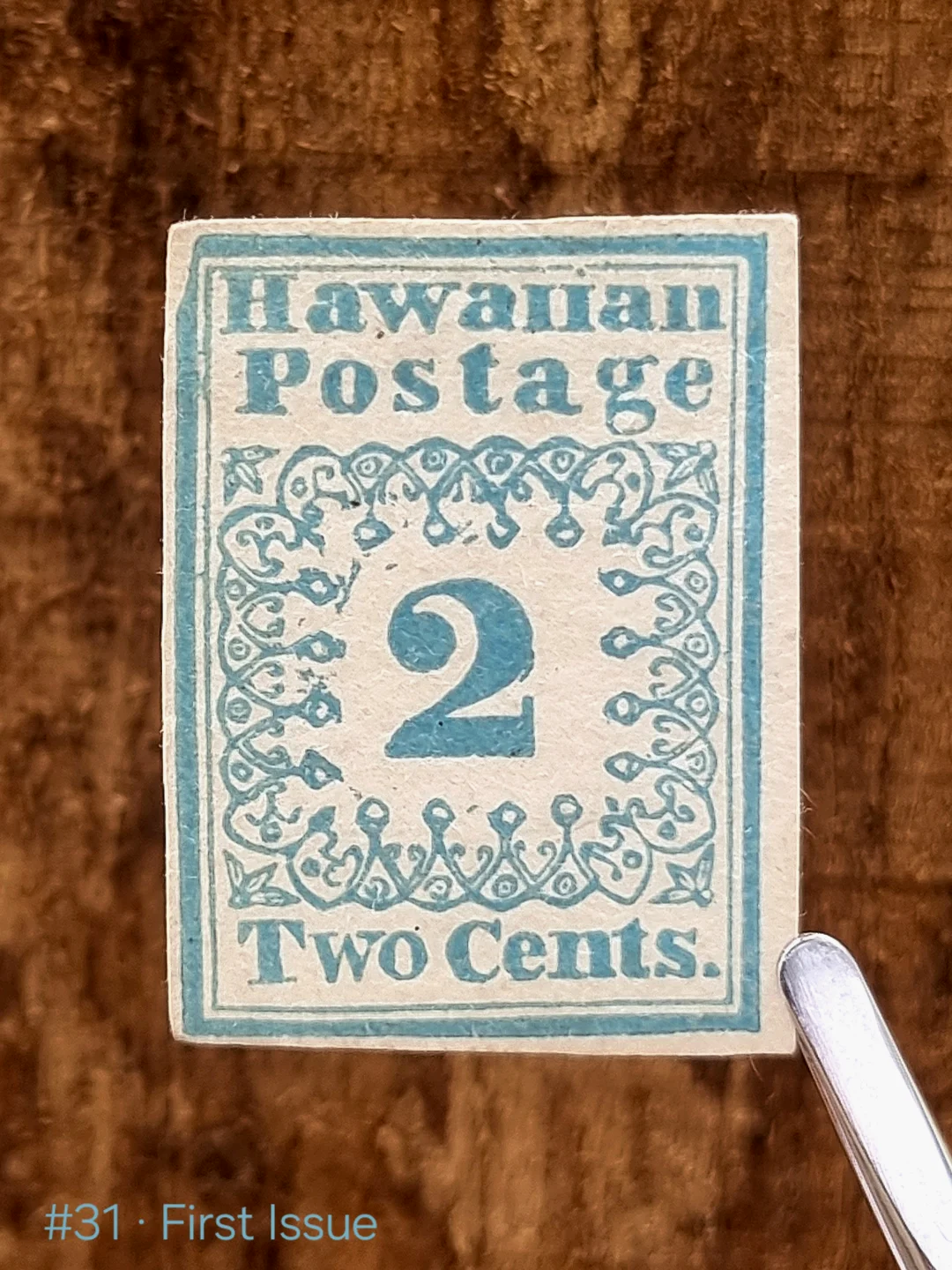
The legendary Missionaries and their shadows
The originals, the Hawaiian Missionaries, stand at the beginning of Hawaiian postal history and rank among the great rarities of classical philately. What is shown here reflects the design, but not one of the surviving 1851 printings. Issued under the Kingdom of Hawaii, the stamps were designed and printed by Postmaster Henry M. Whitney on the press of the government newspaper. Entirely typographic. Entirely local. The first release comprised three values in blue: 2c, 5c and 13c. Two types exist, created by resetting the movable type. They remained valid until about 1856, yet survival is extraordinarily low. Roughly 200 genuine examples are recorded across all values. Genuine copies can reach several hundred thousand US dollars, while major covers have exceeded one million. The most debated are the Grinnell Missionaries. In the 1920s, 43 examples surfaced through George H. Grinnell, allegedly from missionary correspondence. In 1922, they were declared forgeries after court proceedings, although the debate never completely disappeared. In 2006, Mystic Stamp Company acquired 36 and offered the group for US$1.5 million. For collectors wanting to study the design without entering five- to seven-figure territory, the Scott forgeries shown here offer a historically interesting alternative. John Walter Scott produced these reproductions in the 1860s and 1870s for his catalogues, when genuine Missionaries were already extremely scarce. Today, these nineteenth-century reproductions usually trade around US$50. Peter Winter also produced Missionary forgeries in the 1980s. Printed on brighter, more modern paper, they feel quite different from the nineteenth-century reproductions. The Hawaiian Missionaries are one of the defining first issues of the nineteenth century. The originals are rarely seen outside major collections and museums, but even their reproductions reflect how early collectors became fascinated with this remarkable issue.
Stamp Origins on Instagram