1 Jul 1853·South America
ChileFirst Postage Stamp
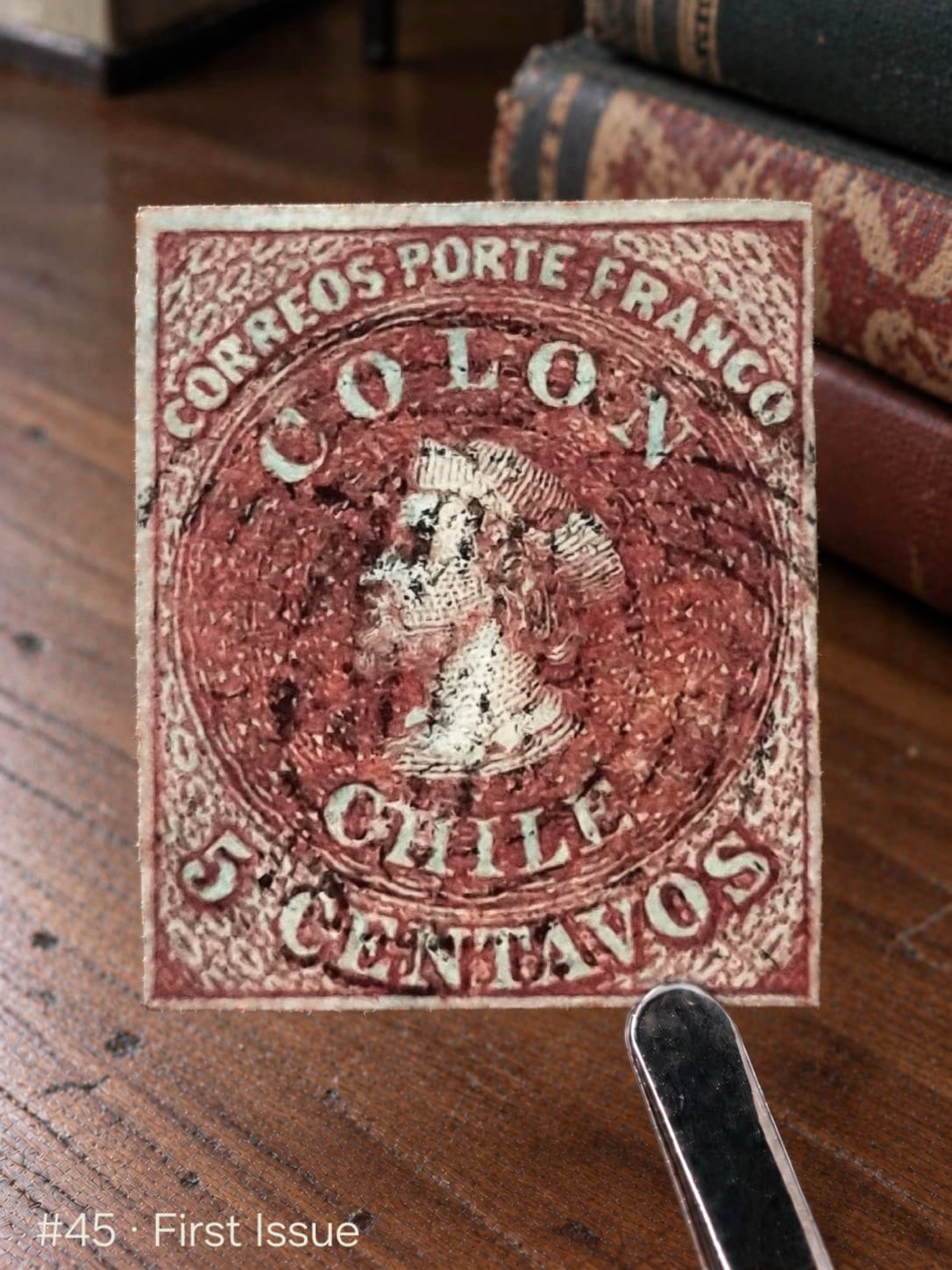
London precision, Santiago character
At first glance, Chile’s first stamps look fairly straightforward: a bust of Christopher Columbus, two values, and one design. Keep reading, and it becomes wonderfully intricate. Issued on 1 July 1853, the imperforate 5 centavos red-brown and 10 centavos blue were engraved and printed in London by Perkins Bacon, the firm behind the Penny Black, the world’s first postage stamp. They were produced in a similar size and share the distinctive style seen across several early Perkins Bacon issues. Parts of the Chilean design were later incorporated into South Australia’s first stamps. The original plates were then sent to Chile, where local printing began in 1854. Desmadryl’s engraved impressions can closely resemble the London originals, while Gillet’s emergency lithographed 5c looks noticeably flatter. These differences help distinguish the first London issue from later local printings. Production later moved to the Santiago Post Office, where changing inks, different papers, and increasingly worn plates produced impressions ranging from crisp and detailed to coarse or blurred. The stamps were watermarked with their respective values, 5 or 10, with the numerals sometimes inverted, reversed or sideways. Early London printings are also found on strongly blued paper. Uneven blueing can leave Columbus’s face noticeably paler than the surrounding design, creating the striking "Ivory Head" effect shown here. Add numerous forgeries, official reprints, and private reprints such as the Hahn printings of 1910, and two seemingly simple stamps become a serious identification challenge.
Stamp Origins on Instagram