1 Oct 1856·South America
Uruguay, Carrier
Diligencias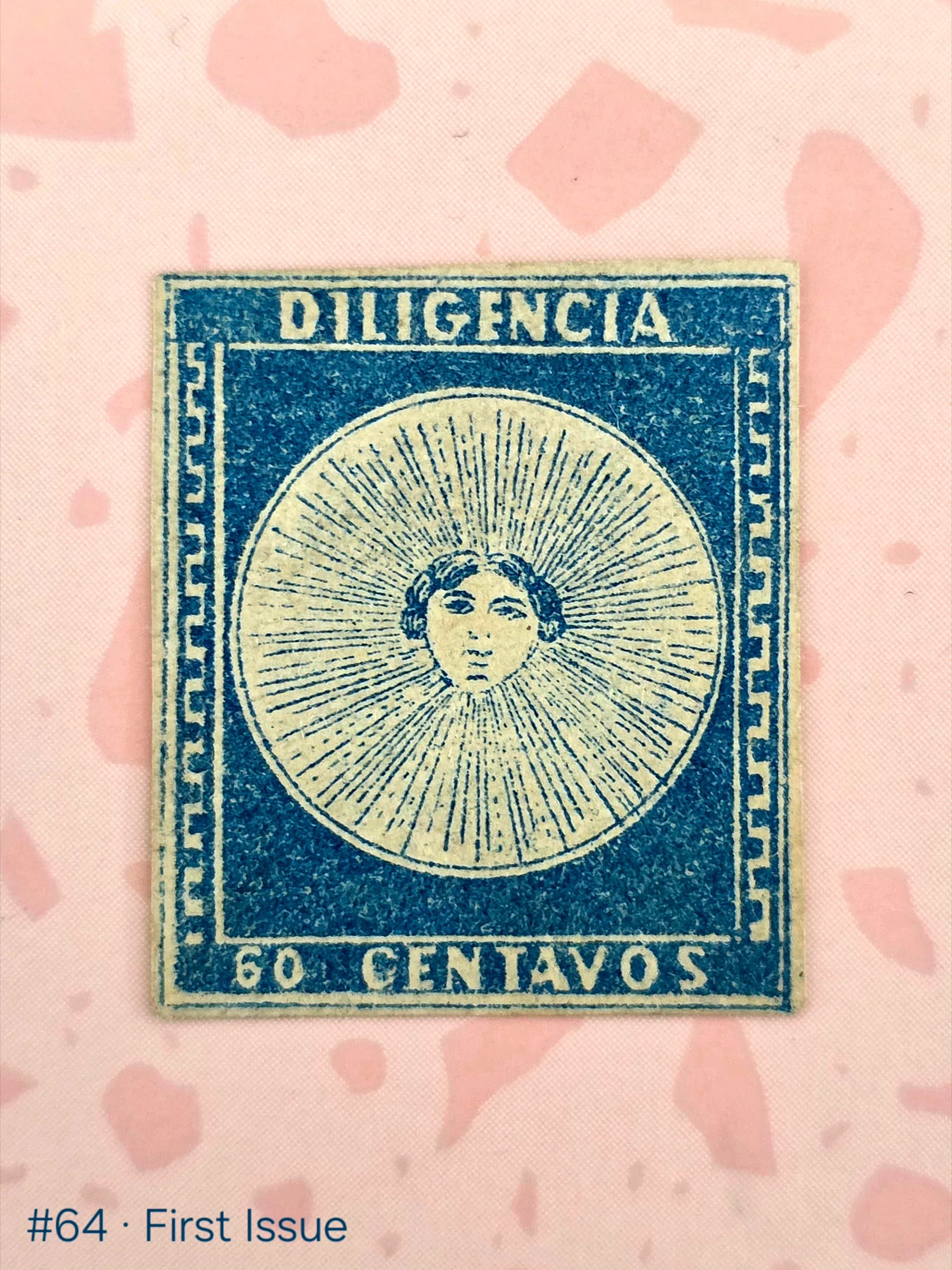
60c blue, likely Type 7 — Scott 1, SG 1, Y&T 1
A little sun, a long journey
Try to picture Montevideo in October 1856. You have a letter to send inland and a stagecoach waiting to carry it. At the post office, a new way to pay: an adhesive stamp showing a sun with a human face. I like imagining that first encounter with something we now take for granted. Uruguay’s first stamps took their name from “diligencia”, meaning stagecoach. Intended for domestic mail, the set comprised three values: the 60 centavos blue shown here, 80 centavos green and 1 real vermilion. A redesigned 60c followed in 1857, with 67 sun rays and different side borders. The Greek-key pattern seen here was replaced by short vertical strokes, an easier identification clue than counting every ray. They were ordered by Atanasio Lapido, both Administrator General of Posts and the contractor running the inland mail service. Often described as a private issue, they are nevertheless recognised by Uruguay Post as the country’s first stamps. The accepted issue date is 1 October 1856, although the exact timing remains debated. Lithographed in Montevideo in sheets of 35, the stamps were closely spaced, making four clear margins particularly desirable now a days. In Uruguay Filatélico, Amílcar J. Fita identified 16 positions where identical printing flaws appear on all three values. A crack in the stone left a white line across three neighbouring stamps. The line appears in the same positions on the blue, green and vermilion stamps, showing that all three were printed from the same single plate. Sperati forged them and even adopted their sun for his own “Philatélie d’Art” seal. There’s clearly something about this little sun that’s hard to resist.